Table of Contents
If your AI system is classified as high-risk under the EU AI Act, you face the full weight of compliance obligations: Article 12 automatic logging, Article 9 risk management, Article 11 technical documentation, Article 14 human oversight, and more.
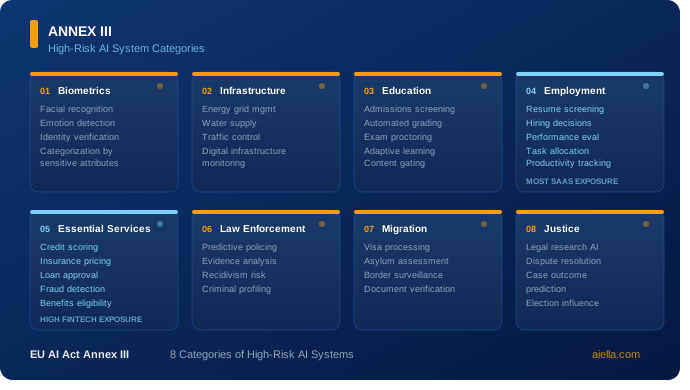
Whether your system is high-risk depends almost entirely on one thing: does it fall into one of the eight categories listed in Annex III of the EU AI Act?
This post walks through each category with specific product examples that SaaS companies will recognize. If you see your product in any of these descriptions, you are likely in scope.
A Key Point Before We Start
An AI system listed under Annex III is presumed high-risk unless the provider can demonstrate it does not pose a significant risk of harm to health, safety, or fundamental rights. In practice, that exemption is narrow. The European Commission’s draft guidance published in May 2026 favors a broad initial reading of these categories. If your system is capable of falling within a category, the starting assumption is that it does.
This matters for US SaaS companies in particular. The EU AI Act applies to any AI system that affects people in the EU, regardless of where the company is incorporated. If your product has EU users and falls into an Annex III category, you are in scope.
Category 1: Biometric Identification and Categorization
This covers AI systems used for remote biometric identification (matching one person against a database of many), biometric categorization (inferring sensitive attributes like race, political opinions, or health status from biometric data), and emotion recognition.
Examples you might recognize: Facial recognition for access control. AI that infers age, gender, or ethnicity from photos. Emotion detection in customer service calls. Sentiment analysis systems that attempt to gauge emotional state from voice patterns.
What catches people off guard: Emotion recognition in workplace settings (monitoring whether employees look engaged during meetings) falls squarely in this category. So does any system that categorizes people by race, gender, or disability status from images or video, even if that categorization is a secondary feature rather than the primary purpose.
Note: Real-time remote biometric identification in public spaces is largely prohibited under Article 5, not just high-risk. Post-event identification by law enforcement under strict conditions is allowed but classified as high-risk.
Category 2: Critical Infrastructure
AI systems used as safety components of critical infrastructure in energy, water supply, heating, gas, and digital infrastructure. Also covers AI used in road traffic and the supply of water, gas, heating, and electricity.
Examples you might recognize: AI that manages power grid load balancing. Predictive maintenance systems for water treatment plants. Traffic management systems that control signal timing. AI-based network monitoring for digital infrastructure providers.
What catches people off guard: If your SaaS product monitors or manages any infrastructure component that, if it failed, could endanger public safety, you may be in scope. Cloud infrastructure monitoring tools that make automated decisions about resource allocation for critical systems are closer to this category than most teams realize.
Category 3: Education and Vocational Training
AI systems used to determine access to or admission into educational institutions. AI used for evaluating learning outcomes, including systems that determine whether a student passes or fails. AI that determines the appropriate level of education for an individual. AI used to monitor and detect prohibited behavior during exams.
Examples you might recognize: Automated essay grading. AI-powered admissions screening. Adaptive learning platforms that decide which content or difficulty level a student receives. Plagiarism detection systems. AI proctoring tools that flag suspicious behavior during online exams.
What catches people off guard: If your edtech product uses AI to decide which courses or content a student can access, that is a decision about the level of education an individual receives. Adaptive learning platforms that seem harmless on the surface can fall into this category because they are effectively gatekeeping educational opportunities.
Category 4: Employment and Worker Management
This is the category that affects the most SaaS companies. It covers AI used for recruitment, screening, filtering, or evaluating candidates. AI used for decisions about promotion, termination, task allocation, and performance monitoring. AI used for evaluating work performance or behavior of employees.
Examples you might recognize: Resume screening tools. AI hiring assistants that rank candidates. Automated interview analysis platforms. Performance management systems that score employees. Workforce analytics tools that recommend who to promote or terminate. Productivity monitoring systems that track employee behavior.
What catches people off guard: The scope is broader than hiring tools. If your SaaS product helps managers evaluate employee performance using AI, or if it recommends task assignments based on predicted employee capability, that falls under employment and worker management. Even “decision support” tools that do not make final decisions but generate rankings or recommendations are in scope because they materially influence the outcome.
This is also the category where the enforcement deadline matters most. Many US HR tech companies have EU users and have not yet assessed their exposure.
Category 5: Access to Essential Services
AI systems used to evaluate creditworthiness or credit scores. AI used to evaluate eligibility for public assistance benefits, social services, or essential private services. AI used for risk assessment and pricing in health and life insurance.
Examples you might recognize: Credit scoring models. Loan approval recommendation systems. Insurance underwriting AI that sets premiums. Fraud detection systems that block access to financial services. AI that determines eligibility for government benefits.
What catches people off guard: Fraud detection is the one most fintech companies miss. If your fraud detection system can block a person’s access to their bank account or prevent a transaction from going through, it is making a decision about that person’s access to an essential financial service. That puts it in this category.
Insurance pricing is another area where companies are surprised. If your AI system influences the premium a person pays for health or life insurance, it is high-risk regardless of whether a human technically approves the final price.
Category 6: Law Enforcement
AI used for risk assessment of individuals (predicting likelihood of committing an offense). AI used for polygraphs and similar tools. AI used to evaluate the reliability of evidence. AI used for profiling during detection, investigation, or prosecution of criminal offenses.
Examples you might recognize: Predictive policing systems. AI-powered evidence analysis tools. Recidivism risk assessment tools used in sentencing or parole decisions.
Relevance for SaaS companies: Most commercial SaaS companies do not operate directly in law enforcement. However, if your product is sold to law enforcement agencies and used for any of these purposes, you are the provider of a high-risk AI system. This includes analytics platforms that are marketed for general use but are adopted by law enforcement for profiling or risk assessment.
Category 7: Migration, Asylum, and Border Control
AI used for risk assessment of people entering the EU. AI used for examining applications for asylum, visa, and residence permits. AI used for detecting, recognizing, or identifying people in the context of migration management.
Examples you might recognize: Automated visa processing systems. AI-powered document verification for immigration applications. Border surveillance systems using AI for person detection.
Relevance for SaaS companies: Similar to law enforcement, most commercial SaaS companies do not operate directly in this space. But identity verification products, document analysis tools, and facial recognition platforms that are used by government agencies for immigration purposes fall into this category.
Category 8: Administration of Justice and Democratic Processes
AI used for researching and interpreting facts and the law and applying the law to a specific set of facts. AI used for alternative dispute resolution. AI used to influence the outcome of elections or referendums, or the voting behavior of people.
Examples you might recognize: Legal research AI that recommends case outcomes. AI-powered contract analysis tools used in judicial proceedings. Chatbots used by political campaigns to engage voters. Automated legal document generation used in court proceedings.
What catches people off guard: Legal tech AI that is used by law firms for internal research is not in scope. The same tool becomes high-risk when it is used in actual judicial proceedings to inform a judge’s decision. The classification depends on how the system is used, not just how it is designed.
What High-Risk Classification Means for Your Engineering Team
If your product falls into any of these categories, Articles 9 through 15 apply. The most technically demanding obligations are:
Article 9: Implement a continuous risk management system that runs throughout the product’s lifecycle.
Article 11: Produce comprehensive technical documentation before deployment.
Article 12: Build automatic logging that captures every inference event with timestamps, model version, input references, confidence scores, and human oversight decisions.
Article 14: Design the system to enable meaningful human oversight, not checkbox oversight where a human rubber-stamps decisions without evaluating them.
These are engineering deliverables that take months to build properly. The enforcement timeline makes starting now the only safe position.
Not Sure Where You Stand?
If you read through these categories and are not certain whether your product is in scope, that uncertainty is exactly what Aiella’s free risk assessment is designed to resolve. You describe your AI system, Aiella classifies your risk tier and identifies your specific compliance obligations. It takes under 2 minutes and requires no account.
Run your free risk assessment at assessment.aiella.com
This post is for informational purposes only and does not constitute legal advice. Consult qualified legal counsel for compliance guidance.